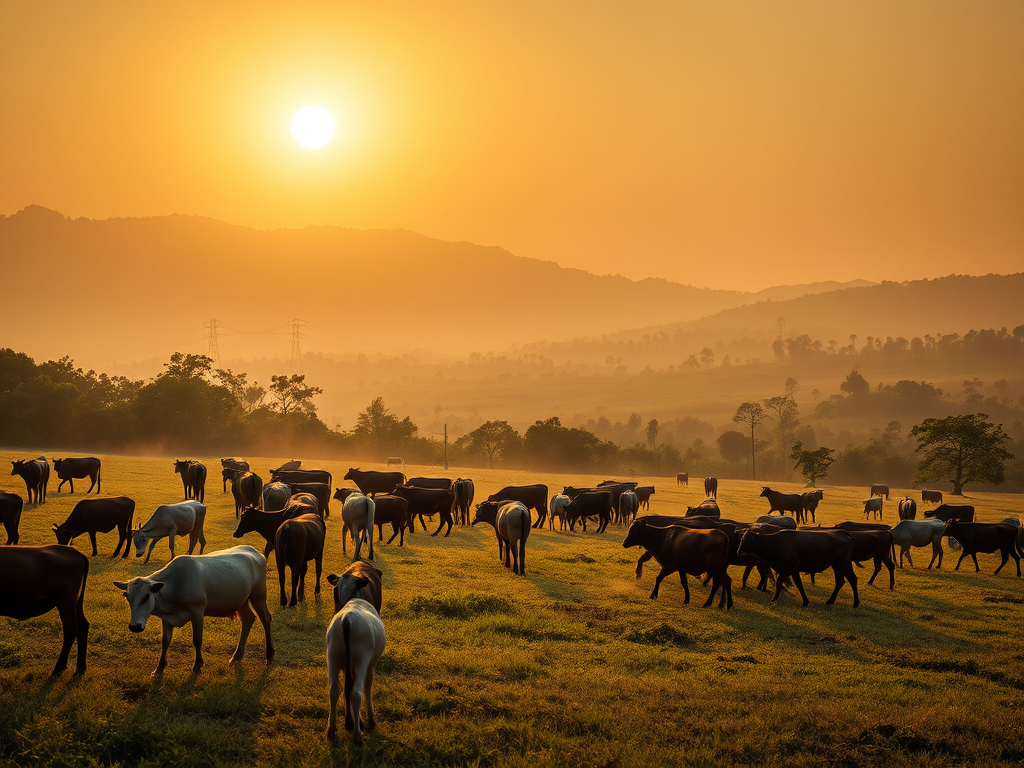
Brazil’s beef industry is a global powerhouse, fueling economic growth and feeding millions both at home and abroad. But a new study suggests that unless production methods change, the sector may struggle to meet international climate goals—and could lose tens of billions in the process.
Published in Environmental Science and Pollution Research, the study analyzed projected greenhouse gas emissions from Brazilian beef production through 2030. It found that under current practices, emissions could reach between 0.42 and 0.63 gigatons of CO₂ equivalent (GtCO₂e). That’s more than double the 0.26 GtCO₂e limit needed for Brazil to meet its commitment under the Paris Agreement.
For the study, researchers used the social cost of carbon—an economic measure of the long-term financial impact of carbon emissions—to evaluate the consequences. Their results? If emissions remain high, Brazil could face costs of up to $42.6 billion USD by 2030 due to climate-related damages. But adopting low-emission practices could significantly cut those losses.
Brazil’s beef exports hit a record in 2023, reaching 2.29 million tons sold to 157 countries and generating $10.55 billion USD. But the study shows that without emissions reductions, Brazil might need to scale back domestic beef consumption to stay within its climate targets—down to as little as 2 to 10 kilograms per person per year by 2030, depending on the scenario.

The issue isn’t just the cows—it’s how the land is used. Between 1985 and 2022, Brazil’s agricultural land area grew by 50%, with pastures now covering 164.3 million hectares—more than half of all agricultural land. According to MapBiomas, 64% of this expansion came at the expense of native forests, especially in the Amazon.
Author Simone Miraglia stresses that the risks of inaction aren’t just environmental—they’re economic. Rising temperatures are already linked to reduced crop yields, more forest fires, and higher health costs.
The study argues that success will require more than good science. It calls for stronger partnerships between researchers and rural producers, greater government involvement.
The message is clear: In a world with increasing climate catastrophes such as wild fires and hurricanes, we must change what we consume to mitigate these problems otherwise they will continue to get worse, placing national security and economic security at risk for humans all over the world.
MV da Cost et al. Brazilian beef production and GHG emission – social cost of carbon and perspectives for climate change mitigation. Environmental Science and Pollution Research (2025). https://doi.org/10.1007/s11356-025-36022-1