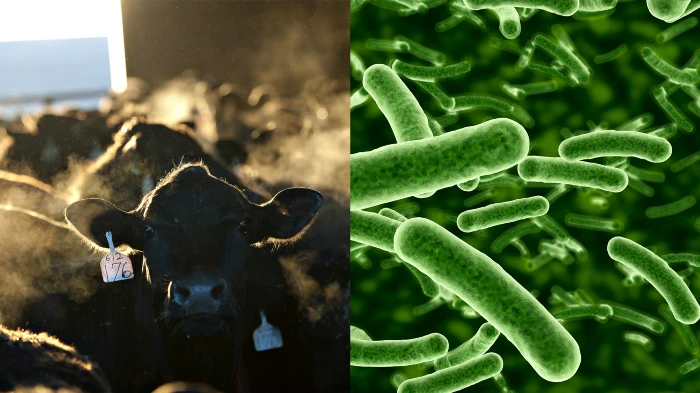
Industrialized farming assumes the myth that its practices lower the risk of zoonotic diseases (those transmitted from animals to humans) due to better control, biosecurity, and livestock separation. However, a study from the University of Exeter suggests that social and economic factors, typically overlooked, play a crucial role in disease risk. The paper, published in Royal Society Open Science, reveals that intensifying agriculture may, in fact, increase the risk of emerging infectious diseases (EID).
Traditionally, assessments concentrate on microbiological, ecological, and veterinary sciences, but this study highlights the necessity of incorporating social, economic, and political factors.
“Disease is always more than a matter of pathogen transmission, contact and contagion,” states author, Stephen Hinchliffe.
“The founding myth in intensive farming is that we separate livestock from wildlife and thereby shut off the risk of diseases passing between them.
“But these farms exist in the real world—so buildings and fences can get damaged, wildlife like rats or wild birds can get in, and workers move around. In short, there will always be accidents.
“Once social, economic and political factors are taken into account, the pandemic risk posed by intensive farming is concerning.”
The study underscores that intensive farming expansion and environmental degradation can heighten EID risks. Intensification creates a “mixed landscape” with varied farming practices, which is detrimental to EID risk.
On biosecurity, the study points out that some farm businesses struggle with the costs, and regional differences matter. For instance, European farms often have old, costly buildings, whereas U.S. farms use open-air concrete structures to save on air conditioning, and subtropical farms must balance biosecurity with preventing animal overheating. Thus, achieving a fully bio-contained environment is nearly impossible.
“The result is a far from bio-contained environment,” wrote the authors.
The study also highlights the close ties between large food companies and national authorities, indicating “regulatory capture” and difficulty in separating these interests.
“Increasing on-farm biosecurity, standardization, and efficiency in farm animal production is not the panacea for achieving a disease-free environment,” said co-author Kin Win (Ray) Chan.
“Rather we need to reconsider the socio-cultural impacts of intensifying farm animal production on planetary health, environmental sustainability and animal welfare issues.”
Industrial animal agriculture is perhaps one of the biggest single security risk to nations through its intense damage to the environment and high risk to people’s health. One such risk highlighted in this paper is that these farms are reservoirs for all sorts of virulent pathogens that will eventually affect human health at large. Such practices should be reconsidered and replaced with sustainable practices that relies significantly less on animal-based products.
S Hinchliffe et al. Understanding the roles of economy and society in the relative risks of zoonosis emergence from livestock. Royal Society Open Science (2024). https://doi.org/10.1098/rsos.231709