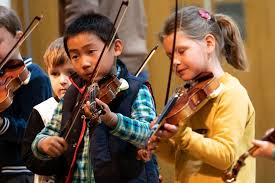
Utilizing MRI to study the brains of secondary school children, researchers in Japan found that students who learned to play music at a young age exhibited certain brain activities more strongly than children who did not.
Splitting 98 children into three groups: Group S, Group E, and Group L. Group S were students trained in the Suzuki method, an education system created by Sinichi Suzuki where students were musically trained which parallels the linguistic environment of acquiring a native language. Group E were students who learned music at an early age but not in the Suzuki Method. Group L were students who never learned music or were trained in music later in life.
During MRI scanning, students were exposed to music with intentionally embedded errors in pitch, tempo, stress, and articulation for which the students were to identify.
Group S and E showed greater brain activity than Group L in identifying pitch, tempo and articulation areas of the brain ash were associated with language. In addition, Group S showed unique patterns of activation in area of the right brain areas associated with emotion and melody.
“One striking observation was that regardless of musical experience, the highly specific grammar center in the left brain was activated during the articulation condition. This connection between music and language might explain why everyone can enjoy music even if they are not musical themselves,” stated the authors published in Cerebral Cortex.
While those reading this may be too old to ever be in the learning-music-at-a-young-age category, it’s never too late to learn an instrument and develop parts of your brain. But from a parenting standpoint, music training at a young age should be standard in child-rearing to develop well-rounded children with the plasticity to adapt in a fast, changing society.
KL Sakai et al. Music-experience-related and musical-error-dependent activations in the brain. Cerebral Cortex 2021. bhab478